
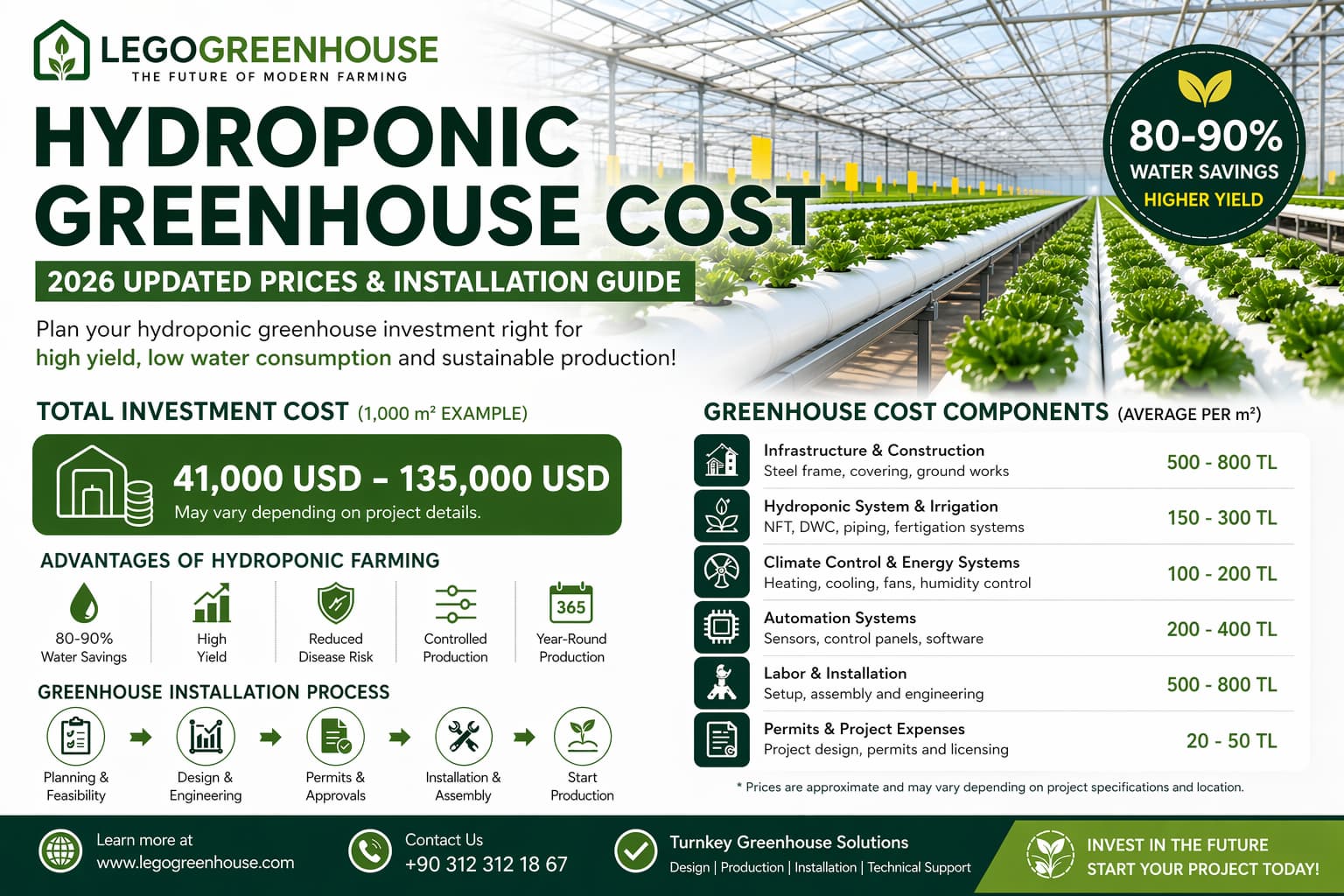
Hydroponic Greenhouse Cost
The hydroponic greenhouse cost is one of the most critical factors for investors planning a modern agricultural project. Hydroponic systems, which enable high-efficiency production without soil, offer significant advantages such as water savings, higher yields, and year-round cultivation. In this comprehensive guide, you will find detailed insights into hydroponic greenhouse cost, cost components, price ranges, and the full installation process.
What is Hydroponic Farming and Its Advantages?
Hydroponic farming is a modern cultivation method where plants grow in nutrient-rich water instead of soil. It is widely used in greenhouse systems to maximize efficiency and control.
Key advantages:
- Up to 80–90% water savings
- Higher yield per square meter
- Reduced risk of soil-borne diseases
- Controlled production environment
- Year-round production capability
Although the initial hydroponic greenhouse cost may seem high, these advantages significantly shorten the return on investment.
What Does Hydroponic Greenhouse Cost Include?
A hydroponic greenhouse investment consists of multiple cost components. Understanding each one is essential for accurate budgeting.
1. Infrastructure & Construction
Includes steel structure, covering materials (glass, polycarbonate, or polyethylene), and ground preparation.
- Average: 500 – 800 TL/m²
- For 1,000 m²: 500,000 – 800,000 TL
This is typically the largest portion of the total hydroponic greenhouse cost.
2. Hydroponic System & Irrigation
Includes NFT, DWC systems, piping, pumps, and fertigation systems.
- Average: 150 – 300 TL/m²
- For 1,000 m²: 150,000 – 300,000 TL
System selection directly impacts overall cost.
3. Climate Control & Energy Systems
Heating, cooling, ventilation, and humidity control systems.
- Average: 100 – 200 TL/m²
- Total: 100,000 – 200,000 TL
Essential for maintaining optimal growing conditions.
4. Automation Systems
Includes sensors (pH/EC), control panels, and software systems.
- Average: 200,000 – 400,000 TL
Automation increases efficiency and reduces labor costs over time.
5. Labor & Installation
Engineering, assembly, and installation services.
- Total: 500,000 – 800,000 TL
Usually accounts for 10–15% of total investment.
6. Permits & Project Costs
Licensing, engineering drawings, and official approvals.
- Average: 20,000 – 50,000 TL
A small but necessary part of the investment.
Total Hydroponic Greenhouse Cost (Example)
For a 1,000 m² turnkey hydroponic greenhouse, the estimated investment:
- 41,000 USD – 135,000 USD
Costs vary depending on technology level, location, and project scope.
Hydroponic Greenhouse Installation Process
A successful project follows these steps:
1. Planning & Feasibility
Define investment goals, crop selection, and budget.
2. Design & Engineering
Select greenhouse type and system design.
3. Permits & Approvals
Obtain necessary legal permissions.
4. Installation & Assembly
Construct the greenhouse and install all systems.
5. Start Production
Begin cultivation with initial planting.
Proper project management ensures optimized hydroponic greenhouse cost and faster ROI.
Is a Hydroponic Greenhouse Profitable?
Yes—when properly planned.
Key profitability factors:
- Crop selection (lettuce, tomato, strawberry)
- Automation level
- Energy efficiency
- Market access
Most projects achieve ROI within 2–4 years due to high productivity.
Turnkey Greenhouse Solutions with LegoGreenhouse
At LegoGreenhouse, we provide:
- Custom greenhouse design
- Turnkey hydroponic system installation
- Engineering and consultancy
- Technical support and after-sales services
We deliver scalable solutions both in Turkey and internationally.
Conclusion
The hydroponic greenhouse cost depends on multiple variables, but it offers strong long-term profitability. With the right planning, technology, and execution, hydroponic greenhouse investments can become highly sustainable and profitable ventures.
